
Overtraining in sport
-
in Blogs

I’ve just finished doing on online lecture on overtraining for the Centre for Nutrition Education (www.cnelm.co.uk) in the UK, so I thought I would share some of my thoughts with you. It’s a topic that is quite close to my heart because on reflection, I probably spent a large proportion of my athletics career in borderline overtraining - the recurrent injuries and infections were not by accident or ‘bad luck’ as some people might attribute them to….
Overtraining syndrome (OTS) has got various definitions in the sports science literature - in fact, scientists have been trying to come up with a concise definition of the state since the 80’s and they are still trying. Thankfully now though, we are starting to accept that it has multiple manifestations and multiple aetiologies, which brings the problem into the realm of functional medicine and nutritional therapy to try and ‘fix’it.
So, what is OTS? In terms of just training, it is very simply a person training harder and recovering less than the body can handle. If you take a look at the diagram below, the top graph depicts somebody who is training hard, becoming weaker as a result (which is the whole point of training), and then rebounding into a new phase of strength. A well timed next training session finds the person stronger than before and so, over time, the person progressively becomes stronger and fitter in a number of different ways; therefore getting closer to their fitness goals.
Conversely, the bottom graph depicts somebody who is doing the same training, but who doesn’t wait long enough before training hard again and therefore never fully recovers - their longterm outcome is actually to diminish their strength and physiological function and to move towards chronic OTS.
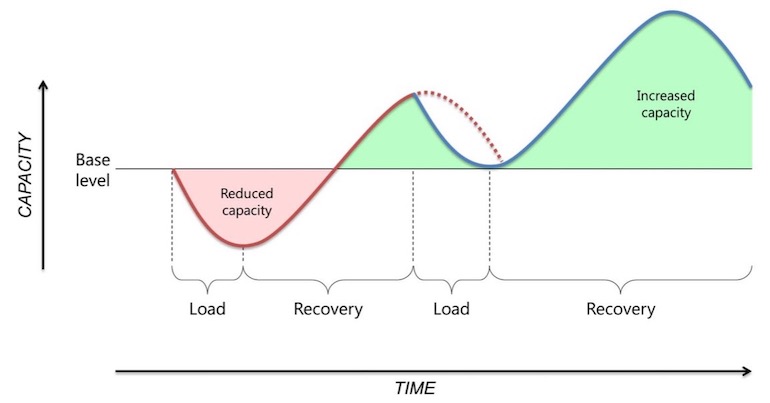

Despite knowing more about training theories and mechanisms of recovery, nowadays we’re in this era of pushing harder and more often, and it is not serving us. Here are two modern scenarios:
- - Somebody training for a long distance triathlon by squeezing in sessions before and/or after work and who feels that they need to fit all three disciplines into each week multiple times.
- Somebody doing ‘functional’ type training such as CrossFit - instead of doing a killer session 2-3 times per week with more gentle background sessions in-between, many people are now doing multiple back-to-back days of killer sessions. Of course, they are mostly training tired and unrecovered and therefore don’t benefit as much as they could from each session.
In both scenarios, there will be a bit of early progression because there are new skills/disciplines being learned, but the plateaux in their performance comes way too early considering the amount of effort that they’re putting in.
Here’s an example from one of my long distance running and triathlon clients. Despite training hard and dutifully with a ‘good’ coach, he told me that his best marathon time had dropped by 15mins over the past three years. Since he’d been only been doing these types of events (marathons, ultras and 1/2 and full Ironman triathlons) for about five years, he had quickly progressed to a mediocre plateaux in two years and has now been progressively getting slower for the past three years - 15mins is a lot of time to drop on a marathon, especially since he now trains harder than ever before.
So far I’ve only talked about training load - we also need to consider life load, which I call Total Load. It is made up of 3 P’s of stress:
- - Physical - such as training, manual work, ergogenics of desk set up, etc.
- Physiological - any gastrointestinal, immune, hormonal, neurotransmitter, musculoskeletal imbalance is a stress on the body and it detracts from how hard an athlete can train.
- Psychological - what we all think of as ‘stress’. If you have pressures at work, pressures at home, or signs of anxiety or depression, you have psychological stress, which will also detract from the energy that you can put into training.
Years ago, when I moved to London from a nearby town, I increased my personal training hours from 20 to 40, I increased my cycle commute from 10mins to 30mins each way, and I was out socialising more than before. I tried to retain my previous levels of training, but made minimal progress in my fitness and became injured even before the track season started that year.
If you are a recreational athlete (i.e. you have to work for a living), in comparison to an elite athlete, you do not have the liberty of sleeping as much as you would like, having as much time to spend on food preparation, or indulging in well studied recuperation strategies, so you need to be careful. Seriously ask yourself whether you give yourself sufficient rest between sessions and if you need to pull back a bit (or a lot) on your training load. If the honest answer is ‘yes’, you will now have more time for sleep, good food, and recuperation strategies, all of which will make you a far better athlete.
Remember, in terms of sport, there is only one thing more important than training and that is recovery….