
Black or white, big or small, OR moderate?
-
in Blogs
“Daddy, is your scooter big?” “Well”, I start to say…., “it’s not as big as my motorbike, but it is bigger than some other scooters, so I guess it’s a medium-sized scooter.”
“Daddy, is your bicycle really big?” “Yes” I say, “my bicycle is really big.” “Is my big bicycle really big?” “Well, it’s bigger than your old bicycle, but smaller than my bicycle…..”
Explaining the concepts of big and small to a 3-year old is tough because the word ‘medium’ or ‘moderate’ hasn’t really entered their vocabulary yet. So a description of something is either this way or that, with nothing in-between.
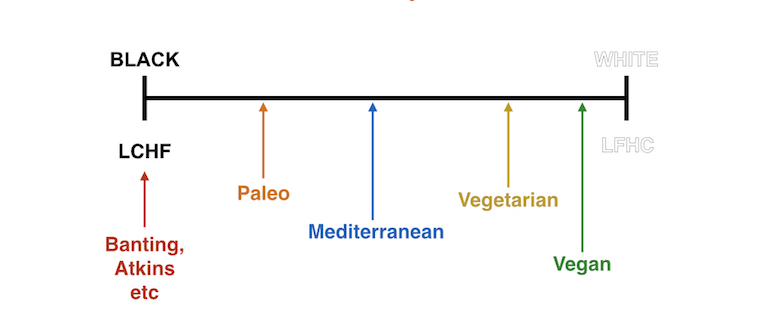
But shockingly, that’s how many of us are thinking about our nutrition these days - rather than calling it ‘big’ or ‘small’, I refer to it as ‘black’ or ‘white’. Either we eat a low-fat high-carb diet, as was the convention from the late 20th century, or we eat a low-carb high-fat diet, which has become popular this century. As I’ve said before, a few of us do fit into these extremes and do very well on these types of diets - I call these people ‘outliers’ though, which is a scientific term for the individuals who fall outside the statistical averages. Just by using the word outliers, it conveys the message that there are not many of you who do well on such an extreme dietary approach.
Even scientists, or should I say, ‘especially scientists’, seem to operate in realms of black and white. For instance, I have a UK colleague who has been researching and practicing the ketogenic (LCHF) diet for the last couple of years - he, unlike many ketogenic enthusiasts, is highly respective of genetic individuality and recognises that it will only work for certain individuals, which is why I listen to what he has to say. He himself was finding that even on his previously very high quality, very balanced diet, that his blood sugar levels were creeping up above reference range, meaning that he possibly has a genetic propensity towards diabetes. Earlier this year, he wrote an excellent article for my Functional Sports Nutrition magazine on the ketogenic approach for athletes - in his research citations, though, he referred to a study that demonstrated greatly improved fat metabolism on a LCHF diet. But, what did the researchers use as a comparison? A very low fat, high carb approach, that’s what. Well, if you’re going to put subjects on a much higher fat diet and give them time to adapt to it, I think it’s common sense that they will learn to metabolise fat significantly better than if there is not much of it in their diet.
What would happen if instead we compared a ketogenic diet to a ‘moderate’ dietary approach that is not low in fat, nor is it high in carbs (especially refined ones) - I’m thinking of traditional approaches like the Paleo and Mediterranean ways of eating. I really doubt that we would see such a big difference in fat metabolism between groups. Additionally, on these more moderate dietary approaches, I think that the subjects would also retain the ability to metabolise carbs well, which is actually extremely important.
But why do we tend to only see black and white comparisons in science like this? Because it is much easier to demonstrate a clear statistical difference between the two diets. By only comparing extreme with moderate, or one type of moderate with another type of moderate, they risk not being able to come up with any conclusions that they can publish.
Back to you as the dietary consumer…. Instead of either thinking about low-fat versus high-fat or low-carb versus high-carb, try thinking about moderation for a change. Despite a few years of Noakes influence, I’m still seeing most people loading up on really crapy carb choices in the supermarket or restaurants. OR, I see people doing a complete Banting approach, who ban every crumb of ‘carbs’ from their house…. but I believe strongly that to restrict your dietary choices so severely, is akin to restricting your soul.
It is totally possible to thoroughly enjoy your food in a non-restrictive way AND improve your health, your waistline and your relationship with food, the live entity that nourishes us each and every day. That ultimately is our philosophy here at the Nutritional Institute - eat and live traditionally, avoid ‘man-made’ food as much as possible, and improve your body-mind health from the inside-out.
Please carry these messages through the coming New Year and start bringing the word ‘moderate’ into your vocabulary, just like our 3 year 4 month old is about to….